


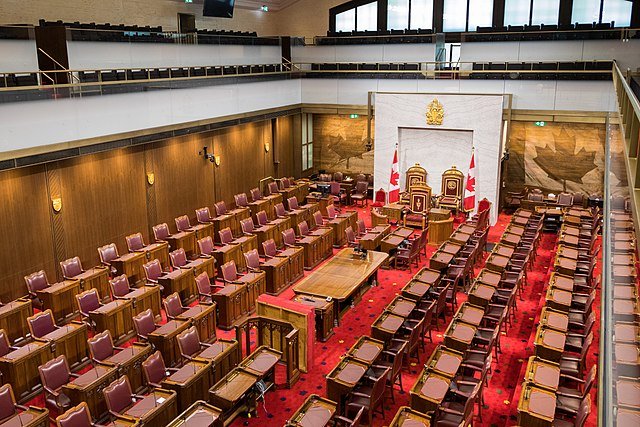
Edmonton, Alberta – In a recent Senate Standing Committee on Indigenous Peoples session, Alberta Senator Scott Tannas urged for clear, verifiable proof regarding claims of unmarked graves at former residential schools, arguing that Canadians deserve solid evidence to build trust and counter skepticism.
The discussion, highlighted in a March 11, 2026, report by Western Standard News, centered on how to address “residential school denialism” amid lingering questions about high-profile announcements, such as the 2021 report of 215 potential graves detected by ground-penetrating radar at the former Kamloops Indian Residential School site.
Senator Tannas, representing Alberta, pressed witness Michael DeGagné, co-chair of the National Council for Reconciliation, on the absence of definitive confirmation in the public domain. “How do we address deniers when we don’t have any kind of solid proof?” Tannas asked. He further noted that many ordinary Canadians remain unconvinced, stating: “You also talked about deniers. I want to put on the table and have you respond to the fact that, at least in the public realm, the average citizen would say there has been no proof. How do we get past this without actually having ‘truth,’ proof?”
DeGagné acknowledged the persistence of denialism but emphasized the importance of commemoration and institutional credibility over attempts to silence critics. “It’s not enough in this time of residential school denialism… to simply go after the deniers and try to silence them,” he responded. “What is most important for us is to form a sound basis of truth and respond in kind every time we hear denialist rhetoric.” He added that credible institutions should continue presenting historical evidence and research to support reconciliation efforts.
The debate draws from broader context, including a 2024 Senate committee report titled Missing Children, Missing Records, which highlighted incomplete historical data on child deaths at residential schools—estimated at around 4,100 by the Truth and Reconciliation Commission (TRC)—with many cases involving runaways, disappearances, or uncertain circumstances. While the TRC and survivor testimonies document tragic losses, including disease, neglect, and harsh conditions, independent verification of specific grave sites has remained elusive in some cases, fueling public debate.
Tannas’s comments reflect growing calls in some quarters for transparent, evidence-based approaches to advance reconciliation. Commemorating known or potential burial sites remains a key recommendation, seen as a way to honor survivors and educate Canadians about the residential school system’s painful legacy.
This issue continues to resonate across Canada, including in Alberta, where Indigenous communities and leaders have long advocated for truth-telling and healing. As discussions in the Senate and beyond evolve, the emphasis on verifiable facts may help bridge divides and support meaningful progress toward reconciliation.